A Mohali-based SaaS company spent four months trying to fill a senior DevOps role through job portals. Three offers were made. Two candidates ghosted after the second interview. The third accepted a counter-offer from their current employer the night before joining. That’s eight weeks of lost runway on one hire — and it’s not an outlier. It’s the default outcome when companies try to cover Chandigarh, Mohali and Panchkula with a single-city hiring strategy.
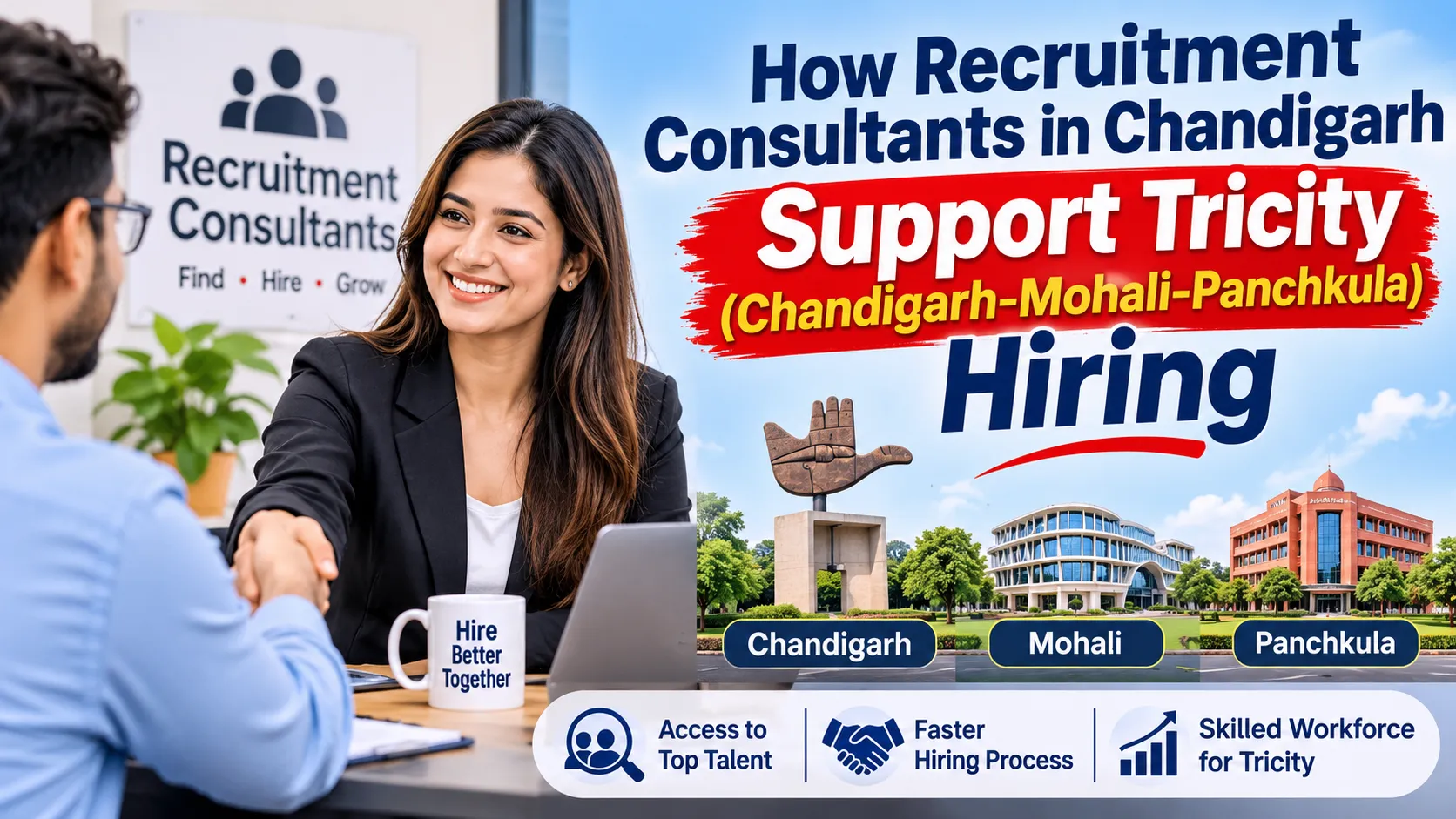
Tricity hiring doesn’t work like metro hiring. The talent pool is smaller, more interconnected, and candidates routinely compare offers across all three cities before deciding where to commute. A business that only sources in Chandigarh is quietly ignoring two-thirds of the available pool. This is the specific gap a recruitment agency in Chandigarh with tricity-wide sourcing capability is built to close.
Why Single-City Sourcing Fails in a Three-City Labor Market
Chandigarh, Mohali and Panchkula function as one economic unit but three separate administrative zones. Salary benchmarks differ. Commute tolerance differs — a candidate in Panchkula will often reject a Mohali IT park role purely on travel time, regardless of compensation. And because the pool overlaps so heavily, the same passive candidate might appear in searches run independently by three different companies in the same week, without any of them knowing it.
Internal HR teams rarely have bandwidth to run parallel searches across all three cities while also managing onboarding, compliance and attrition. Most teams are built to manage headcount, not to hunt for it. That’s the operational reason recruitment consultants in tricity Chandigarh Mohali Panchkula get engaged mid-search, not at the start — companies try DIY first, lose six to eight weeks, then outsource once the internal pipeline has already run dry.
There’s also a visibility problem specific to this region. Job boards tend to geo-tag listings by the posting city, so a Chandigarh-listed vacancy often won’t surface for a Panchkula candidate browsing filtered results, even though the commute is under thirty minutes. Nobody designed the portals with tricity logic in mind. Fixing that gap manually, city by city, is exactly the kind of unglamorous legwork that internal teams skip under deadline pressure.
What a Tricity-Focused Agency Actually Does Differently
Generic staffing firms post a job description and wait. A consultant working the Chandigarh Mohali Panchkula recruitment corridor does the opposite — they already hold warm relationships with candidates who aren’t actively looking, built from years of prior searches in the same sectors.
T&A HR Solutions, headquartered in Chandigarh, runs this model with more than 10 years of recruitment experience spanning 20+ industry verticals — IT, manufacturing, healthcare, pharmaceuticals, BFSI and engineering among them. The sector range matters here specifically because Tricity’s economy is split: Mohali carries the IT and startup weight, Chandigarh carries BFSI and government-adjacent services, and Panchkula carries a manufacturing and healthcare base. A consultant who only understands one vertical can’t actually service the region well, no matter how many resumes they collect.
Their senior-led approach centers on three things:
-
Targeted candidate sourcing — building a shortlist from mapped talent, not inbound applications
-
Passive talent acquisition — reaching candidates currently employed and not browsing job boards
-
Confidential executive searches — for roles where the incumbent can’t know a replacement is being sourced
That last point is routinely underestimated. A CFO replacement search run openly can tank investor confidence or trigger a resignation before a backup is in place. Confidentiality isn’t a nice-to-have in those searches. It’s the entire mandate. Senior-led sourcing also means the person running the search understands enough about the function — finance, engineering, plant operations — to screen out candidates who look good on paper but would fail in week three.
Matching Hiring Models to Actual Business Stage
A seed-stage startup in Mohali and a 15-year-old manufacturing firm in Panchkula have nothing in common operationally, but both might call the same recruitment consultant Chandigarh teams have used for years. The difference shows up in which hiring model fits, and getting this wrong is more common than most hiring managers admit.
T&A structures its engagements around four models:
-
Permanent staffing — for roles where long-term retention is the priority metric
-
Success-based recruitment — fee tied to a completed hire, lower upfront commitment
-
Retained executive search — for leadership and specialist roles requiring dedicated sourcing time
-
RPO (Recruitment Process Outsourcing) — for companies scaling fast enough that internal HR can’t keep pace with volume
Startups usually start with success-based recruitment because cash flow is tight and risk needs to stay low. Established enterprises with recurring senior vacancies tend to move toward retained search, because the cost of a bad senior hire is far higher than the retainer fee. A manufacturing firm scaling shop-floor headcount ahead of a new plant line often needs RPO instead — the volume alone makes per-hire fee models inefficient. Getting this match wrong — say, running an RPO model for a single confidential CFO search — wastes both time and budget, and usually ends with the client switching models halfway through anyway.
When the Tricity Pool Isn’t Enough
Here’s the part most tricity-focused messaging skips: sometimes the region genuinely doesn’t have the candidate. A niche pharma formulation specialist, a specific ERP implementation lead, a bilingual BFSI compliance officer — these profiles can be thin even across a combined Chandigarh-Mohali-Panchkula search. No amount of local relationship-building fixes a pool that’s too small to begin with.
This is where pan-India reach stops being a marketing line and starts being operationally necessary. T&A’s presence across multiple states means a Panchkula manufacturing client isn’t capped at whoever happens to live within commuting distance — specialised and large-scale hiring needs get sourced nationally when the tricity talent market can’t cover them alone, while routine volume hiring still runs through the regional network.
The honest trade-off: pan-India sourcing takes longer and usually costs more than a local hire. Relocation negotiations alone can add weeks. It’s not the default move. It’s the fallback when local sourcing has been tried properly and still comes up short, and a good consultant will say so upfront rather than running a long national search for a role that could’ve been filled locally in three weeks.
What This Means for Hiring Managers Right Now
If your last three hires took longer than 60 days, that’s a sourcing-radius problem before it’s a compensation problem. Check whether your current approach — internal or agency — is actually searching Mohali and Panchkula candidate pools, or just posting a Chandigarh job and hoping tricity candidates apply inbound. Most don’t. The candidates worth hiring rarely are.
Work With T&A HR Solutions
T&A HR Solutions has spent over a decade building the candidate relationships that make tricity hiring work — across IT, manufacturing, healthcare, pharma, BFSI and engineering. Whether the need is a single confidential leadership hire or volume staffing across Chandigarh, Mohali and Panchkula, the team structures the engagement around the hiring model that actually fits the business stage. Reach out to T&A HR Solutions to scope your next hire properly.
FAQs
-
How is a tricity recruitment agency different from a standard staffing firm?
A standard firm posts and waits for applicants. A tricity-focused agency actively sources across Chandigarh, Mohali and Panchkula simultaneously, including passive candidates not currently applying anywhere.
-
Which hiring model should a startup choose first?
Success-based recruitment is the usual starting point — lower upfront cost, payment tied to a completed hire, and lower risk while cash flow is still tight.
-
Why would a company need pan-India sourcing if it’s hiring locally?
Niche technical or compliance-heavy roles sometimes don’t have enough qualified candidates within the tricity pool. Pan-India sourcing fills that specific gap without replacing regional hiring for routine roles.
-
How long does confidential executive search typically take?
It varies by seniority and sector, but it generally runs longer than standard hiring because sourcing happens quietly, without a public job posting signaling the vacancy.
